

BECS 184 : Data Analysis in English Solved Assignment 2025-26
Assignment Title : BECS 184 Solved Assignment in English
Course Code : BECS 184
Course Title : Data Analysis
Assignment Code : BECS 184/TMA/2025-26
Maximum Marks : 100
Title : BECS 184 Solved Assignment in English 2025-26
Course : BAG/CBCs
University Name : IGNOU
Service Type : Solved Assignment (Soft Copy)
Language : English Medium
Session : Valid for Admission July 2025 and January 2026
Short Name : BECS 184
Assignment Code : BECS 184/TMA/2025-26
Product : Assignment of BECS 184 (IGNOU)
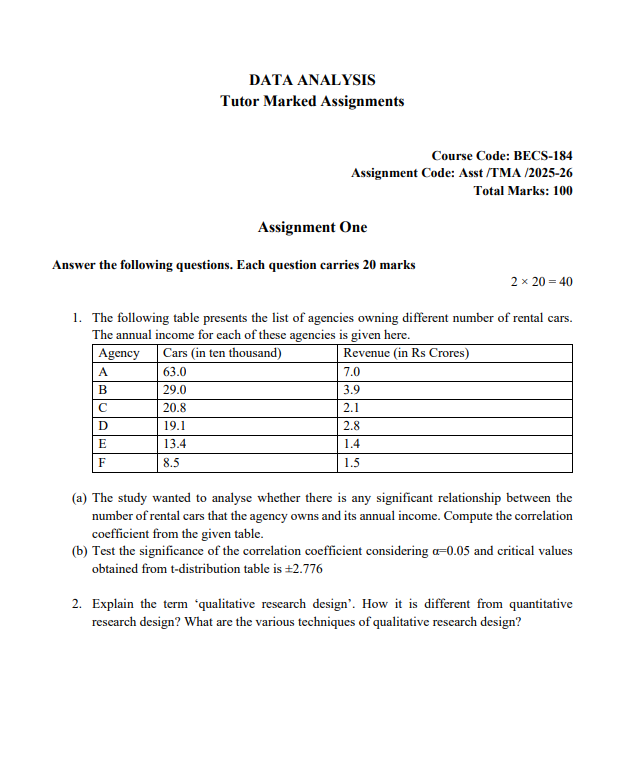
Assignment One
Answer the following questions. Each question carries 20 marks
1. The following table presents the list of agencies owning different number of rental cars. The annual income for each of these agencies is given here.
Agency Cars (in ten thousand)
(a) The study wanted to analyse whether there is any significant relationship between the number of rental cars that the agency owns and its annual income. Compute the correlation coefficient from the given table.
(b) Test the significance of the correlation coefficient considering a=0.05 and critical values obtained from t-distribution table is ±2.776
2. Explain the term ‘qualitative research design’. How it is different from quantitative research design? What are the various techniques of qualitative research design?
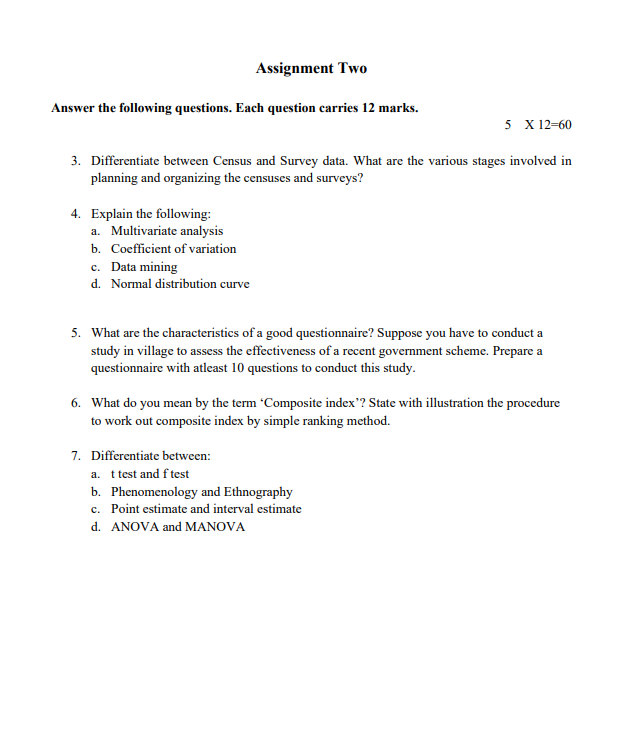
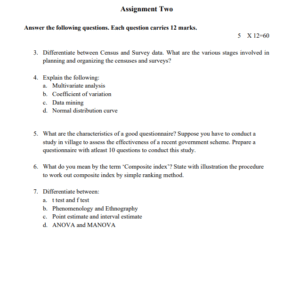
Assignment Two
Answer the following questions. Each question carries 12 marks.
3. Differentiate between Census and Survey data. What are the various stages involved in planning and organizing the censuses and surveys?
4. Explain the following:
a. Multivariate analysis
b. Coefficient of variation
c. Data mining
d. Normal distribution curve
5. What are the characteristics of a good questionnaire? Suppose you have to conduct a study in village to assess the effectiveness of a recent government scheme. Prepare a questionnaire with atleast 10 questions to conduct this study.
6. What do you mean by the term ‘Composite index”? State with illustration the procedure to work out composite index by simple ranking method.
7. Differentiate between:
a. t test and f test
b. Phenomenology and Ethnography
c. Point estimate and interval estimate
d. ANOVA and MANOVA